
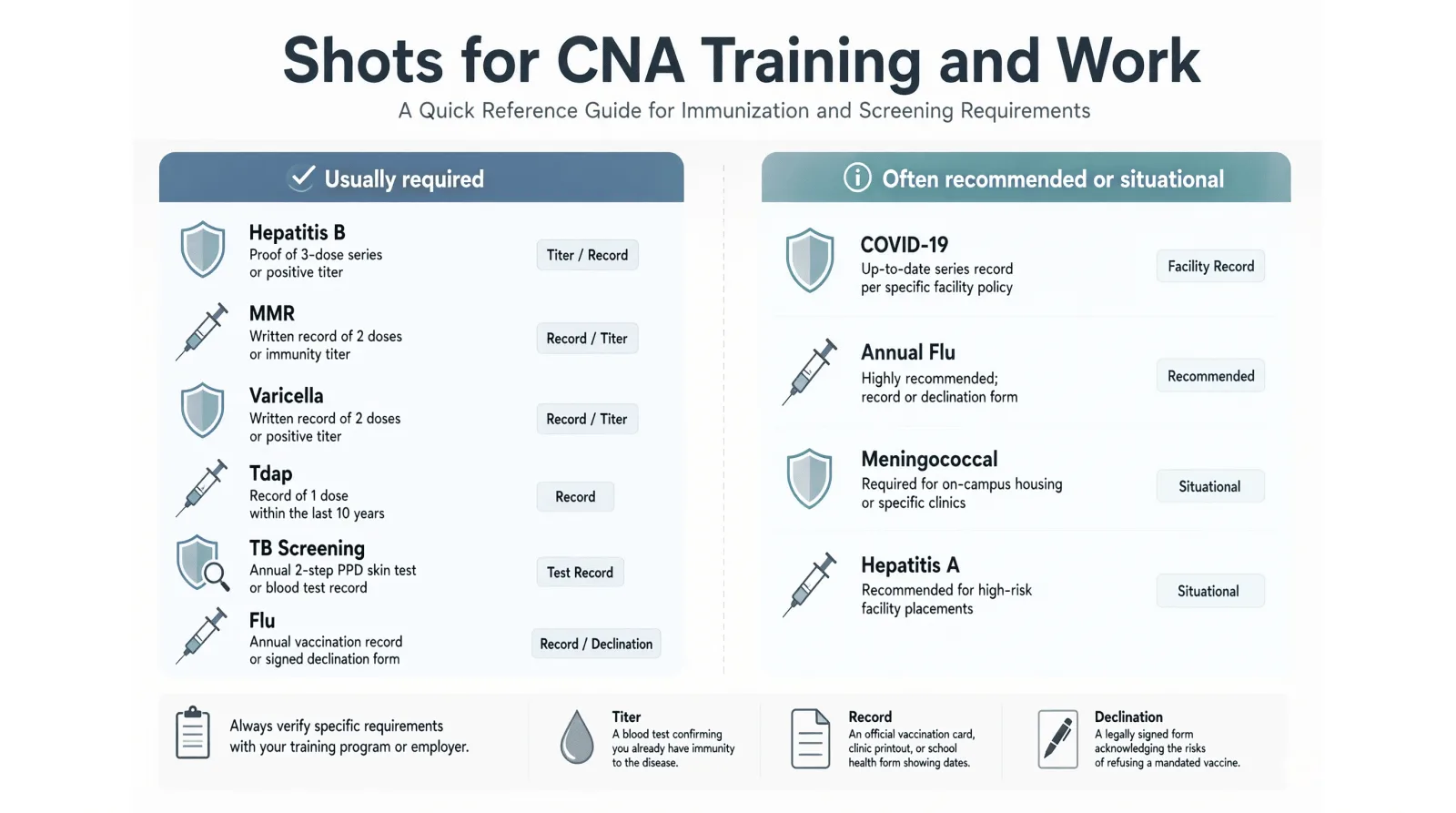
There is no single national list of shots required to become a CNA. What you actually need depends on your state's nurse aide registry, your training program's clinical placement contract, and the healthcare employer that hires you. In practice, most students must show proof of hepatitis B, MMR (measles, mumps, rubella), varicella, and Tdap, plus a TB screening, before they begin clinicals. That means the vaccine question is really a documentation question: programs want a record they can file before your first shift, not just a verbal assurance.
Why CNA Programs Require Vaccines
Nurse aides work in close contact with residents who are frail, immunocompromised, or recovering from surgery. An infection you carry without symptoms can spread from your hands to a resident's bloodstream during a single care episode. Immunization requirements exist to protect residents first and you second. The legal foundation comes from federal infection-control standards for nursing homes, which surveyors enforce. Training programs and clinical sites mirror those standards because they send students into the same buildings. Your state registry and the facility's own policy add another layer. Requirements change, so treat any list as a starting point and confirm with your program coordinator in writing.
Shots Most CNA Students Need to Prove
The table below reflects what is commonly requested by US nurse aide training programs and employers. It is not a legal requirement list for any specific state.
| Vaccine | Protects against | Typical proof accepted |
|---|---|---|
| Hepatitis B | Bloodborne liver infection spread by needlesticks and body fluid exposure | 3-dose series dates, or a positive surface antibody titer |
| MMR | Measles, mumps, rubella; airborne and highly contagious | 2-dose record or positive IgG titers |
| Varicella | Chickenpox and shingles; dangerous to residents with weakened immunity | 2-dose record, titer, or documented history of disease |
| Tdap | Tetanus, diphtheria, pertussis | One dose within the last 10 years |
| Influenza | Seasonal flu | Current-season record or an approved declination form |
| TB screening | Not a vaccine, a test for latent or active tuberculosis | Two-step skin test, IGRA blood test, or chest X-ray if positive |
COVID-19 vaccination is the most variable item. Some states and employers require it; many dropped mandates after 2023. Check your program's current student handbook rather than relying on what a classmate told you last year.
What Each Vaccine Protects Against on the Floor
Hepatitis B: the one tied to your safety
Hepatitis B is the vaccine most directly aimed at protecting you. Needlesticks, blood splashes, and contaminated sharps are real occupational risks, and the virus can survive on surfaces longer than most people expect. The series is three doses over about six months, so starting late is the most common reason students miss clinical clearance. If you have already completed the series, ask for a titer; if it is negative, a booster or repeat series may be needed. For more on bloodborne pathogens, see where bacteria grow best.
MMR and varicella: the airborne risks
Measles and chickenpox spread through the air, not just through contact, which is why facilities are strict. A single case in a nursing home can trigger isolation of an entire wing. Most adults born before 1957 or who had the diseases as children still need documentation, because memory of illness is not accepted as proof by most programs. Understanding modes of transmission helps you see why these requirements matter.
Tdap: the one with an expiration date
Pertussis (whooping cough) can be lethal to a newborn or a frail elder, and immunity fades. Programs want a Tdap within the past 10 years, and some want it within 5. Put the date in your phone calendar so you are not scrambling before a renewal.
Influenza: required, recommended, or declinable
Flu vaccination is often mandatory during the season for staff in certified facilities, but many employers allow a signed declination with a mask requirement during outbreaks. Your training program may accept either. Read the fine print; a declination can carry mask-wearing obligations you should know about before you sign.
TB Screening Is Not a Shot, but It Is on the Same Form
Almost every program requires tuberculosis screening before clinicals, and students routinely confuse it with a vaccine. It is a test, usually a two-step tuberculin skin test (PPD) or an IGRA blood draw. A positive result does not end your CNA path; it means a chest X-ray and a clearance note from your provider. Timing matters: the two-step PPD requires two visits 1–3 weeks apart, so a last-minute student cannot finish it in a week. If you have had a BCG vaccine in the past, tell the clinician, because it can affect skin test interpretation. For a deeper look at infection control, see OSHA for CNAs.
Where the Requirements Come From and Who to Ask
Three sources set the rules, and they do not always agree: your training program, your state nurse aide registry, and the clinical site or future employer. The program sets the deadline for clinical clearance and decides which proof it accepts. The state registry may list immunization or health requirements in the candidate handbook; others leave it to programs and employers. Facilities can require more than the state does, especially for flu and COVID-19. When rules conflict, the stricter one usually wins for clinical placement. Ask your coordinator for the requirement list in writing on day one of class, and confirm any state-level rule directly with your CDC immunization schedule for health care personnel and your state health department's nurse aide page.
How to Get Your Records Together Without the Panic
Most clearance delays are paperwork problems, not medical ones. Work through this in order:
- Request your immunization record from your childhood provider, high school, or state immunization registry. Many states have an online portal.
- If records are missing, ask your provider about titer testing instead of repeating vaccines you may already have had.
- Schedule the hepatitis B series early; it takes months, not days.
- Complete the TB screening last, so the result is recent when you submit.
- Keep a scanned copy in your phone and a printed copy in a folder. You will be asked for it again at hire and at renewal.
- If you have a medical or religious exemption, ask the program how to file it before the deadline, not after.
Documentation habits you build now carry into the job. The same precision that gets a vaccine form accepted is what keeps a documentation question from tripping you up on the written exam: objective, dated, and complete.
Common Mistakes That Delay Clinical Placement
- Assuming the program's list is the same as the employer's. They often differ, especially on flu and COVID-19.
- Waiting on the hepatitis B series. Three doses over six months cannot be compressed into two weeks.
- Submitting a titer without the lab report. A verbal "I'm immune" is not proof.
- Letting Tdap lapse. A 12-year-old dose will be rejected.
- Ignoring a declination's conditions. Signing one may commit you to masking during outbreaks.
None of these are clinical failures; they are administrative ones, and they are entirely preventable with a calendar and a folder.
Practice questions
Tap or click a card to flip and see the answer with clinical rationale.
Sample Question 1
A nurse aide is hired at a nursing home and is offered the hepatitis B vaccine at no cost. What is the most accurate statement about this offer?
- A. The aide must pay for the vaccine personally.
- B. Employers must offer the vaccine to employees with occupational exposure risk.
- C. The vaccine is only for nurses, not aides.
- D. The aide may only be vaccinated after one year of employment.
Tap to reveal answer
Answer & Rationale
OSHA's bloodborne pathogens standard requires employers to offer hepatitis B vaccination at no cost to workers with reasonably anticipated exposure to blood or body fluids, which includes nurse aides.
Tap to return to question
Sample Question 2
A resident with active chickenpox is admitted. Which precaution does the nurse aide expect to follow?
- A. Standard precautions only
- B. Contact precautions only
- C. Airborne and contact precautions
- D. Droplet precautions only
Tap to reveal answer
Answer & Rationale
Varicella spreads by both airborne and contact routes, so both sets of precautions apply. This is also why varicella immunity is checked before clinical placement.
Tap to return to question
Sample Question 3
Which action best breaks the chain of infection when a nurse aide moves between residents?
- A. Wearing gloves for all tasks
- B. Performing hand hygiene before and after each resident contact
- C. Changing the bed linens daily
- D. Keeping the door to the room closed
Tap to reveal answer
Answer & Rationale
Hand hygiene is the single most effective step. Gloves do not replace it, and they are not a substitute for cleaning your hands after removal. For more practice, try our safety practice test.
Tap to return to question
Frequently asked questions
Can I start CNA training before I finish my shots?
Often yes for classroom work, but clinical placement usually requires completed documentation. Ask your coordinator exactly which items must be done before the first clinical day.
What if I was vaccinated as a child and have no records?
Titer testing can show immunity for MMR, varicella, and hepatitis B without repeating doses. Your provider can order these.
Do I need the COVID-19 vaccine to be a CNA?
It depends on your state, program, and employer. Many mandates have been rescinded, but some facilities still require it. Confirm current policy directly rather than relying on older information.